

A Two-Lens Approach to Our Economic Context
PARC’s Autumn Economic Outlook, with Archie Hall: A two lens approach to our economic context
With so much going on in the global economy, when asked to do a 40-minute summary, where do you start?
For PARC’s Autumn Economic Update, Archie Hall chose to focus on two areas taking up most of his research time at The Economist – the impact of AI and the rising levels of government debt in the advanced economies.
Both these subjects are inextricably linked. The lack of productivity growth since the 2008 Financial Crisis has led to weak economic performance, a rise in government borrowing and rocketing government debt-to-GDP ratios. Previous periods of high growth have been powered by technological advances. Economists, politicians and business leaders are hoping that a new tech revolution will deliver a productivity boom to lift us out of the synchronised stagnation we have been stuck in for two decades.
Unfortunately, even any early signs that this might be starting to happen just aren’t there. As Archie noted, while there is clear evidence of AI’s rapidly advancing capabilities, particularly in some junior-level professional tasks, there are no signs of significant increases in productivity growth in the US or any of the OECD economies. After the post-Covid rebound, the advanced economies appear to have reverted to the low growth pattern of the previous decade.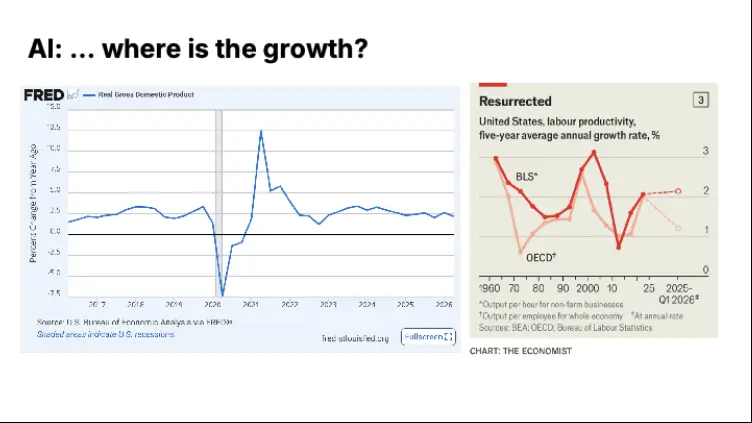
The same is true of the labour market. Changes in the occupational mix since 2022 are not showing much difference from previous periods. The job churn is no greater than might have otherwise been expected. Similarly, unemployment rates have not shown much increase outside that which might be expected in an economic slowdown. In most advanced economies, employment rates are down from their pre-Covid records but they are still high by recent historical standards. There is evidence of significant job losses since 2023 among younger workers in some occupations but this may be due to wider economic factors. As yet, there is little conclusive evidence of AI having a significant aggregate impact on the labour market.
Where there is plenty of evidence of AI’s impact is in the level of investment in tech companies and the construction of data centres. A vast expansion is due in the US by 2030. This is making a clearly visible impact in physical terms – the appearance of vast data centres across the country – but also, perhaps more surprisingly, in its political impact. As Archie pointed out, data centres are becoming very unpopular. There is a strong correlation between rising support for the Democratic Party and the closeness of people’s homes to data centres. The proportion of US voters citing AI as an important issue has risen from 25% to 50% since the 2024 presidential election.
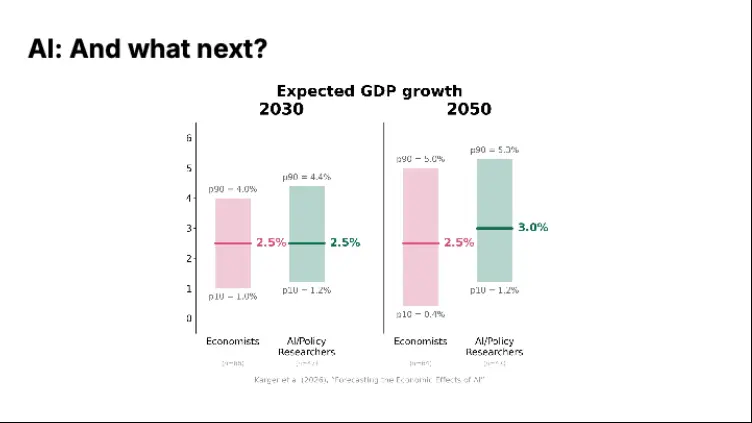
Technology-related investment is now reaching the levels last seen in the US during the technology boom of the 1990s. This investment did deliver a significant productivity boost – the last one the advanced economies saw before the slump of the 2000s. Might this renewed investment lead to another period of rapid GDP growth? The forecasters don’t seem to think so. Even the AI policy researchers are only slightly more optimistic than the economists and few are predicting US growth to be much higher than it has been in recent years.
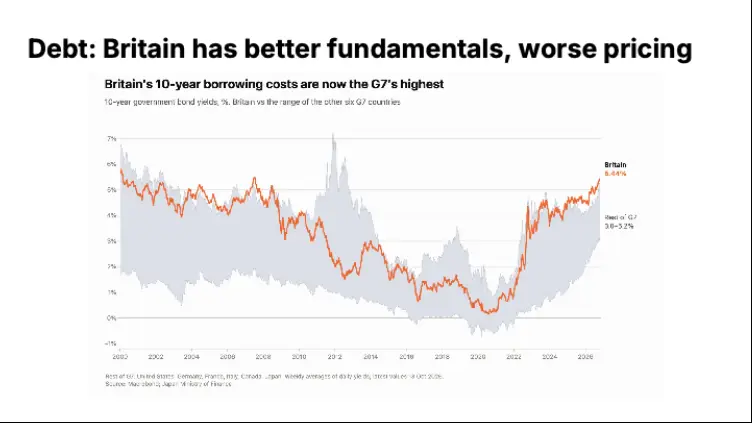
That is unfortunate because, without a sustained period of 1990s-style growth, it is difficult to see how the world’s major economies will get themselves of the fiscal malaise which has built up since the 2008 Financial Crisis. Government borrowing among the major economies has risen since the Covid pandemic, adding to stocks of government debt that were already high by postwar standards. While government borrowing costs were relatively low in the last decade, bond yields have shot up since 2020, so the cost of servicing this increased debt is only adding to the problem.
Archie identified the main potential trouble spots in the G7 as France, with a debt-to-GDP ratio of 110.2%, and the USA, with a debt-to-GDP ratio of 98.5%. Both are running high deficits. US government borrowing is at its highest level outside the Financial Crisis and Covid periods. These high deficits are leading to rising borrowing costs for the US and France. Both countries are experiencing a degree of political instability which, in turn, is likely to make investors demand higher interest rates. (Japan and Italy have higher debt levels but are running significantly lower deficits.)
While UK economic growth has been unexpectedly high in recent months and is currently the highest in the G7. The recent IMF forecast was encouraging. However, the UK also has the highest ten-year borrowing costs in the G7, due to high levels of inflation and the lack of the implicit EU backstop enjoyed by those in the Eurozone. The UK may be more exposed to AI because of its reliance on services exports. Services make up close to 60% of the UK’s total exports, increasing from 50% since Brexit and significantly higher than the G7 average of 38%. These insurance, accounting, legal and consultancy services may be threatened by the increased use of AI.
With ageing populations, shrinking workforces, rising geopolitical pressures and the looming threat of climate change, pressure on public finances is only going to increase. The major economies need a productivity boost simply to stop their stocks of debt from increasing, let alone being able to reduce them. Without significant improvements in productivity, governments may attempt to stabilise their public finances is through the sort of fiscal consolidation (tax rises or spending cuts) that increases political instability.
As we noted in PARC’s April 2026 report The Technology Paradox, while there may be an AI boom going on, turning that into sustainable productivity increases will require a lot of hard thinking within organisations. As Archie’s presentation showed, the productivity gains are by no means a done deal and without them there may be trouble ahead. Paul Johnson may have more to say on that when he joins us in January for our start of year Economic review.
For those with PARC Access, you can watch the presentation here.
With credit to Archie Hall and The Economist for the images.