

Reward in the Age of Volatility: Why steady-state thinking has reached its limits
We have been talking about volatility for years. The VUCA acronym (Volatility, Uncertainty, Complexity and Ambiguity) gained currency around the time of 9/11 and the dotcom crash. Compared to today, though, that period was relatively benign, with high per capita GDP growth in the advanced economies, falling tariff barriers and the former communist economies being integrated into global trade.
The 2020s are very different - at once, more volatile, more uncertain, more complex and more ambiguous than the decades that preceded it. The historian Adam Tooze talks of a "polycrisis" in which "disparate shocks interact so that the whole is worse than the sum of the parts". Working-age populations are shrinking, geopolitical tensions are rising and governments' fiscal headroom is disappearing. Economies across the world have experienced ‘synchronised stagnation’ as productivity and GDP growth remain in the doldrums.
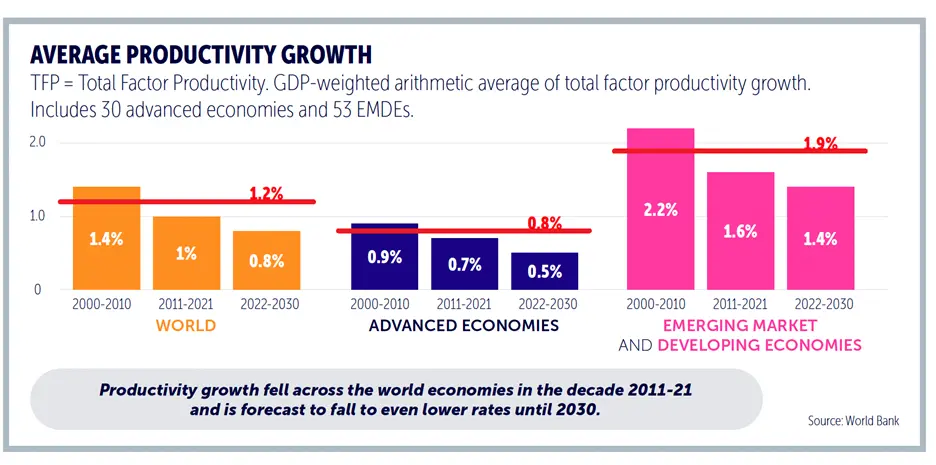
Meanwhile, technologies of extraordinary power are arriving in organisations at a pace that nobody - not the technologists, not the policy-makers and certainly not the regulators - has quite worked out how to manage. The 2020s have turned out to be an age of "Radical Uncertainty", with the potential for any number of perfect storms over the next decade. Organisations are having to respond not only to more volatile business conditions but also to environmental, social and geopolitical factors that have a far greater impact than in recent decades. As the Vice Chair of Mastercard remarked at the 2025 Davos meeting, the ‘one annual dinner’ approach to managing geopolitics isn’t going to cut it any more.
"I think it's safe to say we're living in the most economically disruptive moment since World War II. How you navigate, lead, and problem solve during this period - without a rule book and without precedent - will make or break your corporate strategy."
For reward professionals, this is uncomfortable territory. The function has been built, over decades, on the assumption that the world is reasonably stable: that benchmarks mean something, that an incentive plan designed in March still describes the right behaviours in November. That assumption is wearing thin. As Karen Clark put it in our 2025 report Is Your Organisation Built to Adapt and Survive?:
"Disruption is happening so quickly that a homogenous quarterly briefing is no longer serving all businesses well. Leaders in performance and reward need to be geopolitically and economically aware enough to ensure informed, risk-aware challenge and decision-making."
The trouble is that most reward systems were built for a world that is ending. They reward individual performance against defined targets, reinforce functional specialisms and encourage people to protect their territory. These are precisely the wrong behaviours for a period when organisations need people to experiment, share what they learn, work across boundaries and accept that their roles may change significantly. The misalignment is structural. Reward leaders today are presiding over a system in transition, under pressure to produce certainty without the frameworks to deliver it.
So what is to be done? Three moves stand out.
The first is a candid audit. Reward leaders should be looking not at what their policy documents say the system incentivises, but at what behaviours people have actually learned will be rewarded in practice. If the answer is "hit your numbers and stay in your lane", the incentive system is working against the organisational capital the business now needs to build. The gap between intent and lived experience is where most reward systems quietly come apart, and it widens fastest in volatile periods.
The second is segmentation. A homogenous employee value proposition, with minor variations of grade, is a luxury of stable labour markets. As skills shortages bite and demographic pressure builds, reward will need to flex. Targeting reward to attract critical skills, building credible lateral pathways that do not penalise people for reskilling, and recognising that the deal for an AI-fluent specialist is not the deal for a long-tenured operational manager. These are no longer fringe ideas. There is also a fairness dimension: the IMF has warned that AI is likely to reinforce occupational polarisation, with the highly skilled capturing most of the gains. Reward leaders who preside over that outcome will pay for it in engagement and retention.
The third is horizon-scanning. Businesses will need to get a lot better at anticipating the political, economic and technological shocks that now arrive with some regularity. Reward sits closer to this than it sometimes realises. Pay decisions are quietly contingent on inflation expectations, trade flows, regulatory direction, tax policy and the public mood about executive pay, each of which is more volatile than a decade ago. Running pay budgets, incentive structures and workforce plans against several plausible futures, rather than the one assumed one, is no longer a luxury. It is basic prudence.
None of this resolves the underlying uncertainty. The point is to build a reward function that can flex with conditions rather than brace against them. The organisations that benefited from previous technology waves began building organisational capital before the payoff was visible. The same will be true of those that learn to operate well in volatility: they will adapt their reward architecture before a crisis forces them to.
Which is, in the end, very much reward's territory. Reward is one of the most powerful levers available to a company. Pay and incentive structures shape behaviour and send signals about what an organisation values. This is one of the key mechanisms through which organisational capital is built or eroded. In a period when the capacity of organisations to adapt will determine whether they continue to thrive, the reward function is not a bystander. To meet this challenge, reward professionals need to make the shift from technocrat to strategic thought-leader. The reward leader who remains curious and informed about the world beyond their organisation will be well placed to step into this role.