

Can technology save us from economic stagnation, and how best should we deploy it?
Will technology save us from economic stagnation? It’s a question that economists and policy makers have been asking for some time but there is a new sense of urgency as the economic situation worsens and technology seemingly acquires new capabilities by the day.
The mid-point of the 2020s saw the debate on the productivity puzzle move from concern to panic. After the 2008 Financial Crisis, the advanced economies never regained their pre-crash rates of productivity growth. The hope that the Covid pandemic would re-set the global economy and usher in a ‘Roaring Twenties’ period of growth proved unfounded as the major economies reverted to type and the synchronised stagnation of the 2010s returned. The productivity booms of the advanced economies are now long in the past. Alas, there was to be no salvation in the emerging economies as engines of growth because, after rapid growth in the early 21st century, they too have slowed down.
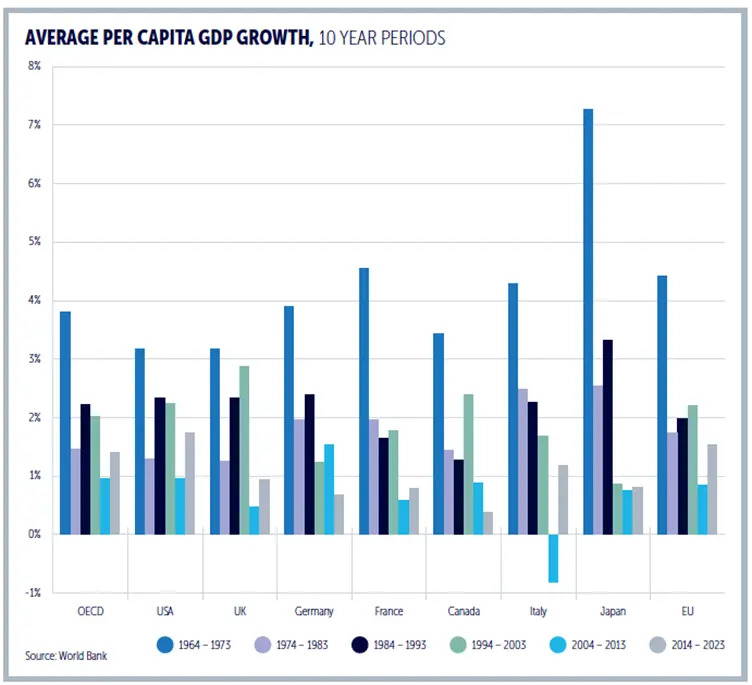
This matters because many of the advances in living standards, security and well-being are the result of rising productivity, as Monetary Policy Committee member Sylvana Tenreyro explained. Conversely, the lack of productivity growth gives rise to polarisation, social fragmentation and a rise in zero sum beliefs, as a recent FT article by John Burn-Murdoch detailed.
The lack of productivity growth would be bad enough on its own but its occurrence at a time when working age populations are shrinking turns it from a problem into a crisis. If the proportion of the population in work shrinks, GDP per hour worked must increase just for an economy to stand still. If it does not, living standards stagnate and government finances become unsustainable without significant tax rises or spending cuts.
A technological leap, with a corresponding leap in GDP per hour worked, offers a potential relief from this conundrum. While many fear the loss of jobs that may arise from the deployment of technology, the scenario in which there is no productivity boost is potentially worse. As economist Duncan Weldon put it, “The only thing worse than the robots taking our jobs is the robots not taking our jobs.”
But since 2008, technology has had very little impact on overall productivity. The long stagnation coincided with the growth of smartphones and the mobile internet. This might have transformed our lives but it hasn’t made us any more productive. Will the rapid advances in AI and robotics be any different?
Many of the recent announcements of re-structures and job losses have cited AI as a major factor. However, economists remain sceptical. A deeper dive into the factors behind the job-shedding suggests that blaming AI may be more a reflection of press-release rhetoric than anything actually happening on the ground.
Deploying any form of technology in a way that will deliver significant productivity improvements is likely to take time and will entail investment in organisational change. Stanford University’s Professor Erik Brynjolfsson remarked:
“General purpose technologies (GPTs) such as AI enable and require significant complementary investments, including co-invention of new processes, products, business models and human capital.”
In a paper for the Productivity Institute, Professor Diane Coyle noted that this is the hard part. Implementing technology is one thing. Reconfiguring your organisation to exploit it is quite another.
“If some firms can use digital technologies so successfully, why can the rest not manage to do so? The answer seems linked to those complementary investments – the general challenge of reorganising production to adopt innovations”.
“Using the new technologies requires complementary investments. These are needed in physical (wired and wireless broadband and data centre) infrastructure, and in organisational change. Of these, the latter seems to be the hardest.”
A McKinsey Global Institute report on productivity pointed out that many of the companies investing in the wave of IT implementations during the 1990s did not see much productivity improvement. Those that gained the most were those that changed their organisations, reskilled their workforces and redesigned their processes alongside the new technology.
“Productivity gains were not automatic and did not occur in all industries that invested heavily in ICT. Instead, real productivity gains required significant changes in business process, as well as managerial and technical innovation.”
There is a danger then that some companies could blow the opportunity of technology by failing to make the necessary organisational changes. There is already some evidence that this may be happening. AI is taking root in companies in a similar way that social media did. Employees are teaching themselves and using it at home, then bringing it into the workplace and deploying it in ways that are beyond the knowledge and control of their managers. In some circumstances, this might raise productivity but, at present, it is difficult to understand the impact on organisations and the level of integration with business processes.
At PARC, we believe that this will be one of the most critical business challenges of the second half of this decade. As those charged with redesigning organisations, reskilling employees and incentivising performance, Reward & HR professionals will be at the forefront of this battle, and so we have organised a conference on the subject which will feature academics, business leaders and technical experts. We will look at what the research is telling us and where the technology is having the most impact. Case studies will focus both on general business applications and on specific uses for the Reward function. This event and the accompanying research report will see the launch of a year-long study on the impact of technology on the PARC Community.
To find out more and register, please go to the event webpage.